Stage Secrets: Why Broadway and Beyond Are Borrowing from Japan's Oldest Performance Arts
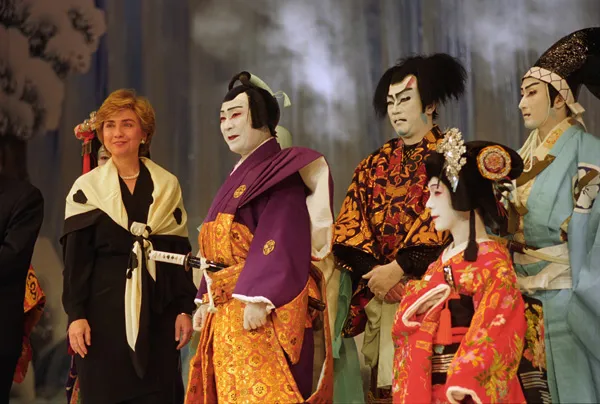
Photo: President (1993-2001 : Clinton). White House Photograph Office. 1/20/1993-1/20/2001, Public domain, via Wikimedia Commons
Picture a Broadway rehearsal room in Midtown Manhattan. The cast of a new production is running a scene — but instead of working on lines or blocking, they're standing perfectly still. For twenty minutes. Just standing, breathing, finding stillness in their bodies. The director, who spent two years studying Noh theater in Kyoto, calls it "learning to listen with your whole body."
This isn't an isolated experiment. Across American entertainment — from Off-Broadway drama to arena-scale concert tours — performers are quietly integrating techniques drawn from Japan's ancient theatrical traditions. And the results are turning heads.
A Different Kind of Stage Training
Most American actors train in systems rooted in European or American traditions — Stanislavski, Meisner, Strasberg. These methods prioritize psychological realism, emotional truth, and the actor's internal experience. They're powerful. They've produced generations of extraordinary performers.
But they have a blind spot, and a growing number of coaches and directors are naming it out loud: they don't always teach performers how to command space.
This is where Japanese theatrical traditions offer something genuinely different. Kabuki — the elaborately stylized Japanese theater form that dates back to the early 1600s — is built on the idea that every gesture, every pause, every flicker of the eyes carries meaning. Nothing is accidental. Everything is choreographed to communicate, to hold an audience's attention across a vast theater with almost no amplification.
Noh, the older and even more austere cousin of Kabuki, takes this further. Noh performers train for decades to master the art of ma — that concept of meaningful pause we touched on in the fashion world, but here applied to breath, movement, and silence on stage. A Noh actor can hold an audience in absolute stillness for minutes at a time, without a single word.
For performers trained in a culture that often equates energy with engagement, this is a revelation.
What the Coaches Are Saying
Hiroshi Tanaka has been teaching Japanese theatrical techniques to Western performers for nearly fifteen years, working with clients ranging from film actors to opera singers. He now splits his time between Tokyo and New York, and his waiting list is long.
"American performers are incredibly expressive," he says. "Emotionally generous. But sometimes that generosity becomes noise. They fill every moment. Japanese training teaches you to trust the empty moments — to understand that what you don't do is just as powerful as what you do."
Tanaka describes a common early exercise he uses with new students: asking them to cross a stage in two minutes. Most performers, trained to stay active, start adding — a glance here, a slight hesitation there. His instruction is always the same: less. Just walk. Trust that the walk itself is enough. "By the end of a week," he says, "they can't believe how much they were cluttering their own performances."
This philosophy aligns with something theater director Amanda Cho — who trained in both Western and Japanese traditions before helming productions in Chicago and Los Angeles — describes as "the courage of stillness." "In America, we're terrified of boring the audience," she explains. "Japanese theater trusts the audience to meet the performer halfway. That trust changes everything."
Case Studies: Where It's Working
The cross-pollination is showing up in some fascinating places.
Take the world of musical theater. Several choreographers working on recent Broadway productions have incorporated elements of Butoh — the avant-garde Japanese dance form known for its slow, deliberate movement and visceral emotional intensity — into ensemble staging. The results create moments that stop audiences cold in the best possible way: a kind of physical poetry that stands out sharply from the high-energy jazz hands tradition.
In the concert world, at least two major touring acts have worked with movement coaches trained in Japanese theatrical traditions to redesign their stage presence. One artist, whose team requested anonymity, described the process as "unlearning every instinct I had about how to hold a crowd." The new approach — more deliberate, more economical with gesture — tested nervously in rehearsal but landed powerfully in front of live audiences. Reviews noted a new "gravity" to the performances.
Even in film and television, the influence is creeping in. Acting coaches in Los Angeles report increased interest from screen actors in what's being called "negative space acting" — using restraint and stillness to create impact on camera in a way that feels distinctly influenced by the precision of Kabuki expression.
The Discipline Question
One thing that comes up consistently in conversations about Japanese theatrical training is the sheer commitment it demands. A traditional Noh actor begins training in childhood and may spend a decade or more before performing a major role. Kabuki families pass technique down through generations, with young performers absorbing craft through years of observation before they're permitted to step into significant roles.
This kind of long-game dedication is genuinely countercultural in American entertainment, where career timelines are compressed and the pressure to produce is constant. But coaches like Tanaka argue that even a relatively brief immersion in these principles can shift a performer's relationship to their craft in lasting ways.
"You don't need twenty years to absorb something true," he says. "You need to be open to it."
Why Now?
The timing of this interest isn't random. American entertainment is genuinely oversaturated — streaming platforms, social media, short-form video have created a landscape where performers are competing for attention at every second. In that environment, the instinct is often to do more. More spectacle, more stimulation, more noise.
Japanese theatrical traditions offer a counterintuitive answer: do less, but do it with complete intention. In a world of constant overstimulation, genuine stillness and precision are almost shockingly powerful.
For those of us at Matsumoto Rio, this feels deeply familiar. The idea that Japanese artistry — patient, disciplined, deeply considered — has something urgent to say to the world is exactly the kind of story we're here to tell. The curtain is rising on a new kind of cross-cultural performance. And the audience is paying very close attention.