Born Again, Again: How Japanese Performers Master the Art of Reinventing Themselves Across Decades
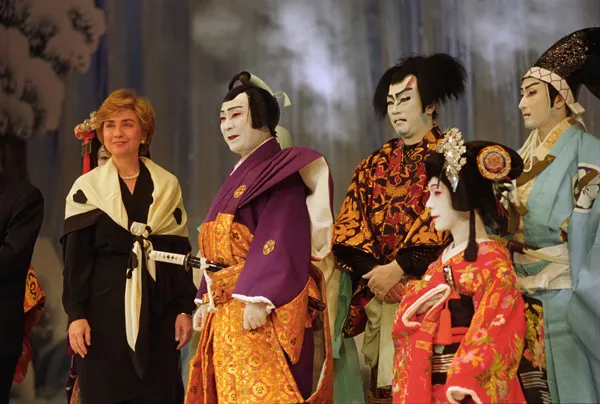
Photo: President (1993-2001 : Clinton). White House Photograph Office. 1/20/1993-1/20/2001, Public domain, via Wikimedia Commons
Let's be honest — the American entertainment industry has a burnout problem. Stars rise fast, dominate for a season or two, and then quietly disappear into a cycle of comeback specials and nostalgia tours. It's a pattern so familiar it barely registers anymore. But spend some time looking at how Japanese performers navigate their careers, and you start to wonder if the whole Western model is just... broken.
Japanese entertainment culture has something the West hasn't quite figured out: a deep, almost philosophical comfort with transformation. Not the desperate "reinvention" of a pop star changing their look mid-career to chase a trend, but something more intentional. More rooted. The kind of reinvention that comes from a culture that has been cycling performers through new identities for literally hundreds of years.
Kabuki and the Blueprint Nobody Copied
If you want to understand why Japanese performers tend to age so gracefully in the public eye, you have to start with kabuki. It's one of the world's oldest continuous theatrical traditions, and it runs on a system of artistic inheritance that's almost completely foreign to Western entertainment logic.
In kabuki, actors don't just learn roles — they inherit names. A performer might spend the early decades of their career under one name, mastering a particular style or character type, and then formally receive a senior name in a ceremony that essentially marks the beginning of a new artistic chapter. The audience doesn't see this as a desperate pivot. They see it as evolution. The performer is expected to be different at 50 than they were at 25, and that difference is treated as something to celebrate.
Compare that to the way American audiences tend to react when a beloved star tries something new. There's suspicion. Nostalgia backlash. A weird cultural pressure to stay exactly the person you were when people first fell in love with you. It's a trap, and a lot of careers have ended in it.
Rakugo's Long Game
Kabuki isn't the only tradition feeding this reinvention culture. Rakugo — the solo comedic storytelling art form where a single performer plays dozens of characters using nothing but a fan and a cloth — has its own version of career longevity wisdom baked right in.
Rakugo performers spend years, sometimes decades, as apprentices before they're even allowed to perform certain classic stories. The expectation isn't that you'll arrive fully formed. It's that you'll grow into the work over time, and that the audience will grow with you. A rakugo master in their 70s performing a story they first attempted in their 30s isn't repeating themselves — they're offering something the younger version of themselves genuinely couldn't.
That long-game mentality shapes how Japanese audiences relate to performers across the board. There's patience built into the culture. A willingness to watch someone become something, rather than just demanding they already be it.
The Idol Pipeline and the Pivot
Now here's where it gets really interesting for American audiences, because this isn't just ancient history. Japan's modern idol industry — the highly structured, intensely managed world of pop groups like AKB48 and its sister franchises — has developed its own surprisingly sophisticated approach to career transition.
If you're not familiar with the idol system, the short version is this: young performers enter groups, build massive fanbases, and then eventually "graduate" — a term that's deliberately chosen to frame departure as achievement rather than failure. What happens after graduation is where the reinvention muscle really gets tested.
Take Atsuko Maeda, one of the most famous graduates from AKB48. After leaving the group at the height of its popularity, she didn't try to stay a pop idol. She pivoted to acting, took on serious dramatic roles, and built a second career that had almost nothing to do with her first one. The transition wasn't seamless, but it was intentional — and Japanese audiences, conditioned by centuries of watching performers evolve, largely followed her.
Or consider Hikaru Utada, who has arguably pulled off one of the most impressive long-form career evolutions in Japanese music history. From teen pop phenomenon to internationally recognized electronic artist, Utada's trajectory has included extended hiatuses, genre shifts, and deeply personal reinventions — and each time, there's been an audience ready to meet the new version.
What Western Stars Keep Getting Wrong
The contrast with American celebrity culture is kind of glaring when you lay it out like this. Western stardom tends to be built on the idea of an authentic self — this is who I really am, take it or leave it. Which sounds great in theory, but in practice it means any significant change reads as fake, calculated, or desperate.
Japanese performance culture operates on a different assumption: that who you are as a performer is always in process. That authenticity isn't about staying static — it's about being genuinely present in each phase of your evolution. The audience isn't buying a fixed identity. They're investing in a journey.
There's also something to be said about the role of mentorship and structure. American stars often navigate career pivots essentially alone, relying on managers and publicists who are incentivized to protect a brand rather than grow a person. The kabuki system, the rakugo apprenticeship, even the idol management structure — all of these create frameworks where transition is expected and planned for, not treated as a crisis.
The Lesson American Entertainers Actually Need
None of this means American performers should start adopting Japanese theatrical traditions wholesale. Culture doesn't transplant that cleanly, and the attempt would probably just produce something awkward and appropriative.
But the underlying philosophy? That's genuinely transferable.
The idea that a career can have multiple distinct chapters — and that audiences can be invited into each one rather than being expected to simply accept it — is something American entertainment could seriously use. So is the patience to develop an artistic identity over time, rather than trying to arrive fully formed and then desperately maintain that image forever.
Some American performers have stumbled onto this intuitively. Madonna's career, whatever you think of her, has followed something like this logic — each era genuinely distinct, the audience invited to engage with a new version. David Bowie built his entire mythology around it. But these are exceptions, not the rule, and they often got there through instinct rather than cultural infrastructure.
Japan has the infrastructure. It's been building it for centuries.
And honestly, watching how performers like Matsumoto Rio navigate the intersection of Japanese artistic tradition and global stages makes the case better than any think piece could. When you're rooted in a culture that treats reinvention as a form of respect — for your craft, for your audience, for the art form itself — you don't burn out. You evolve.
Maybe that's the real secret. Not a trick or a strategy, but a fundamentally different relationship with time.