The Art Nobody Sees: Why Japan's Greatest Performers Train for an Audience of Zero
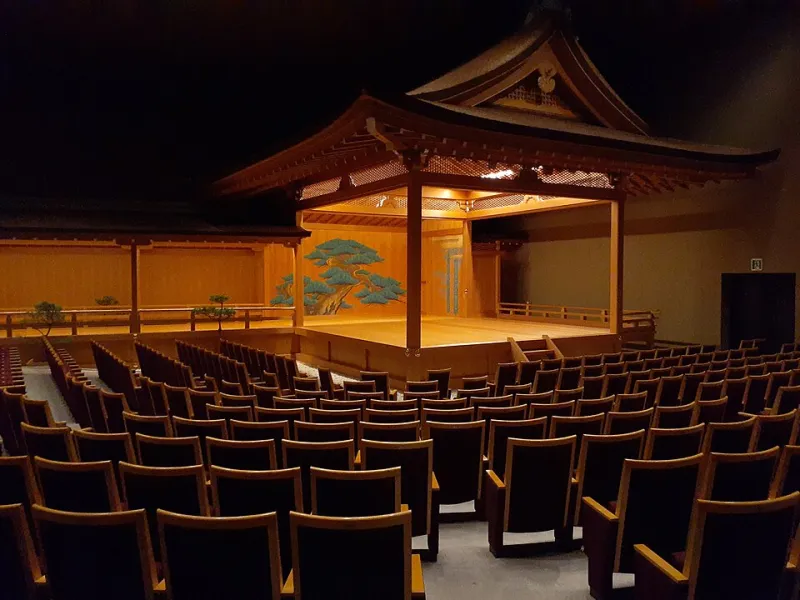
Photo: J. Cuatrocasas, CC BY-SA 4.0, via Wikimedia Commons
There's a particular kind of discipline that doesn't photograph well. It doesn't trend on TikTok. Nobody's going to clip it into a highlight reel or post it under the caption look how hard I work. It happens in cold rehearsal rooms before sunrise, in private studios with the blinds drawn, in the quiet repetition of a gesture that an audience may genuinely never witness.
This is the hidden engine of Japanese performance culture — and it's starting to make a lot of American artists deeply uncomfortable with how they've been doing things.
Mastery Isn't a Performance
In traditional Japanese arts — Noh theater, Butoh dance, classical Koto, even certain schools of contemporary Taiko — there exists a foundational philosophy that runs almost completely counter to Western hustle culture: you practice far beyond what you need. Not to show range. Not to build content. Not because a coach told you to. But because the act of practicing the unseen is itself the point.
Noh actors, for example, spend decades learning kata — precise physical forms and vocal techniques — that exist in the training canon but rarely appear in a standard repertoire performance. A student might spend three years perfecting a particular arm movement that corresponds to a specific emotional register, only to perform a program where that emotion never arises. They learn it anyway. They drill it anyway. Because mastery, in this framework, isn't about what you can demonstrate on command. It's about what quietly saturates every single thing you do.
Think of it like seasoning that dissolves completely into a dish. You can't point to it. You can't isolate it. But the meal is fundamentally different without it.
The Western Attention Economy Problem
Here in the US, performance culture has become increasingly entangled with visibility. We celebrate the process as much as the product — sometimes more. Instagram reels of rehearsals rack up millions of views. Behind-the-scenes footage becomes its own genre of content. Audiences want to see the work being done, and in response, artists have started performing their preparation almost as much as their performance.
That's not inherently bad. Transparency is valuable. But something gets lost when the rehearsal room becomes another stage.
When every hour of practice is potentially content, the practice changes. Decisions get made based on what looks impressive mid-process rather than what actually builds depth. Vulnerability becomes a brand strategy. And the quiet, unglamorous, invisible work — the kind that genuinely transforms a performer from technically proficient to transcendent — starts to feel like a waste of time if nobody's watching.
Japanese performance philosophy offers a direct counterargument: the work that nobody sees is the most important work you'll ever do.
What American Artists Are Discovering
This isn't purely theoretical anymore. Across disciplines — from Broadway choreography studios in Midtown Manhattan to indie music scenes in Austin and experimental theater companies in Chicago — a growing number of American artists are deliberately borrowing from this approach.
Choreographers are assigning dancers technique sequences they have zero intention of staging, specifically to build a physical vocabulary that enriches everything else. Theater directors are having actors rehearse scenes from plays they'll never produce, working through emotional registers that won't appear in the actual show but will inform the texture of every scene that does. Jazz musicians are practicing scales and patterns in obscure modes, not because those modes will show up in their sets, but because fluency in the unfamiliar loosens something in the familiar.
The common thread is this: when you stop training for an audience — even an imaginary future one — you start training for yourself. And paradoxically, that's when audiences feel something they can't quite name.
The Japanese Word That Doesn't Translate Easily
There's a concept in Japanese artistic culture called keiko — often translated simply as "practice" or "rehearsal," but carrying a much richer meaning. The characters that compose it literally suggest something like "reflecting on the old" or "contemplating the ancient." Practice, in this sense, isn't about grinding toward a future performance. It's about deepening your relationship with the form itself, over time, with patience, with humility.
This is the part that tends to short-circuit American brains a little.
We are, culturally, obsessed with outcomes. Practice is justified by what it produces. Time is measured against results. The ROI of rehearsal is the performance. But keiko suggests that rehearsal has intrinsic value — that the repeated, private, invisible engagement with your craft changes you in ways that can't be reverse-engineered from the performance alone.
You can't fake that depth. Audiences feel it even when they can't articulate why.
Restraint as a Form of Generosity
Here's the counterintuitive part: all of this hidden labor, all of this training for an audience of zero, ultimately produces a more generous performance. Not because the performer is showing more, but because they have more to give without showing it.
In Noh theater, the most powerful moments are often the stillest. A trained Noh actor standing motionless on stage carries more weight than most performers generate through elaborate movement — because that stillness is backed by decades of embodied knowledge. The restraint isn't absence. It's presence at full capacity, deliberately held.
American audiences are increasingly drawn to this quality in performance, even when they don't recognize its source. There's a reason certain performers stop a room cold while others, equally technically accomplished, barely register. The difference often isn't talent or training volume. It's the relationship the performer has with their own craft when nobody is watching.
What This Means If You're an Artist Right Now
If you're a performer navigating the current American entertainment landscape — where visibility feels mandatory and every skill needs a showcase — the Japanese model offers something genuinely radical: permission to do the work that doesn't pay off immediately, or visibly, or maybe ever.
Practice something you'll never perform. Learn a technique outside your genre. Drill a scene, a passage, a sequence that has no obvious application to your current project. Not as a productivity hack. Not as content. Just because depth compounds quietly, and the audience — whenever they show up — will feel the difference.
The art nobody sees is still art. In Japan, it might just be the most important kind.